
SEASON 13, EPISODE 21, “A SACRED SYMBOL” EPISODE ANALYSIS BY DANIEL SPINO
Updated: Apr 16

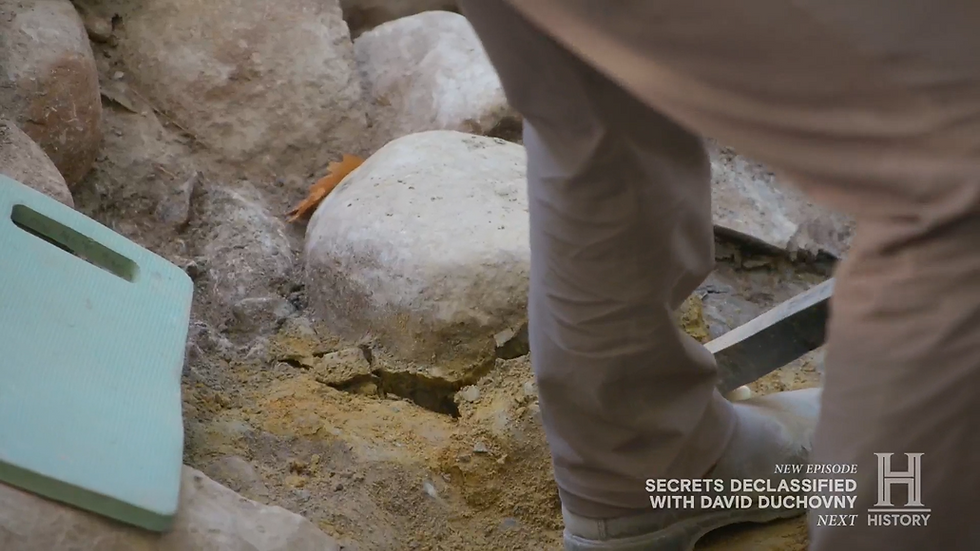
In this week’s episode, “A SACRED SYMBOL”, the show began on LOT 8, where the Oak Island Team continued its investigation and excavation of the area beneath the boulder. The team mentioned that the structure was special and unique and was purposeful and intentional. Archeologist Laird Niven remarked that it was not like any other structure on the island. Archeologist Fiona Steele talked about her work and finding larger stones at the bottom of the structure. She used a pry bar to remove a heavy stone. She then found slate that appeared to be in two layers. The team plans to continue excavating to see what is beneath the structure.


The action shifted to PEACOCK AREA, near the Garden Shaft, where the Oak Island Team continued their excavation to install a caisson. The team had progressed to a depth of 150 Feet, which was dubbed, “Treasure depth”. In this area of the “PEACOCK”, there was a void encountered previously along with a shiny object with water readings that indicated Silver and Gold. Also picked up on the underwater video is what appeared to be manmade workings. This makes sense because the Garden Shaft is in very close proximity to a tunnel running by it. The drill site was named PC-1, Geologist Terry Matheson stated that they would encounter rounded boulders and possibly a wooden structure. The material should be slushy and loose and would go to the bottom of the Solution Channel.


We were then taken to the SOUTHWEST SWAMP AREA, where the Oak Island Team continued its operation at this location which indicated a road was once laid. The team is following where this apparent road is leading. They stated it showed that there was significant work in the Swamp at one time. While working, another 8-sided stake was found. It appeared that the road was made of a layer of sand with rocks on the sides. The team would continue following this feature.
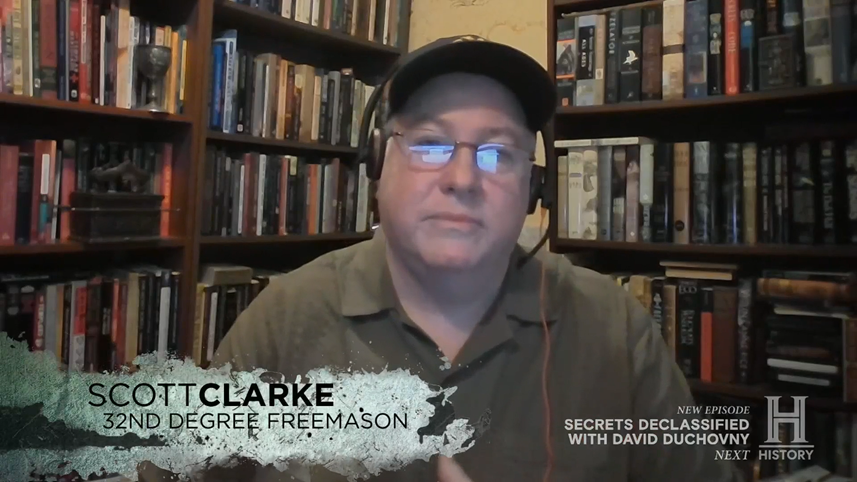


The action then took us to the WAR ROOM, where the Oak Island team met with Researcher Scott Clarke to talk about his belief that a Sacred Relic related to Jesus Christ could have been buried as part of a Templar treasure on Oak Island. Scott went over information from his presentation in 2024 regarding the Charles Morris 1762 Map of Mahone Bay. There were “Masonic A’s” used by Morris on this map that appear to suggest that there was a connection with Oak Island. Scott explained he was surprised when he noticed that this same type of “A” was on the “Titulus Crucis” or “Title of the Cross” that is located at the Basilica of the Holy Cross in Rome, which has a few sacred relics associated with the Passion of Christ. These include the sign or “Titulus Crucis” reportedly placed on top of the cross, a piece of the true cross, and an alleged nail used to crucify Jesus Christ.
Scott then suggested that he believed that it’s possible that a piece of the “True Cross” may have been included in a Templar treasure buried on Oak Island. It was then connected to the same type of “A” associated with the Convent de Christo in Portugal and the Five wounds of Christ that was used on the Portuguese and Azores flags and seals. The Portuguese theory and evidence was then discussed. Scott mentioned, to his credit, that he was not the first researcher to write about the Portuguese Theory. This author presented some of the same information mentioned on the episode, during a War Room presentation to the team in 2022, which this author had published publicly beforehand. The Portuguese or “Pitblado” coin was used as evidence of such involvement. Although it should be noted that the coin is only thought to have been associated with Oak Island. It is pure speculation by Mr. Salomon that it was what James Pitblado found on the auger while drilling on Oak Island. This author believes it was a fragment of natural gold that resides in the Money Pit area.
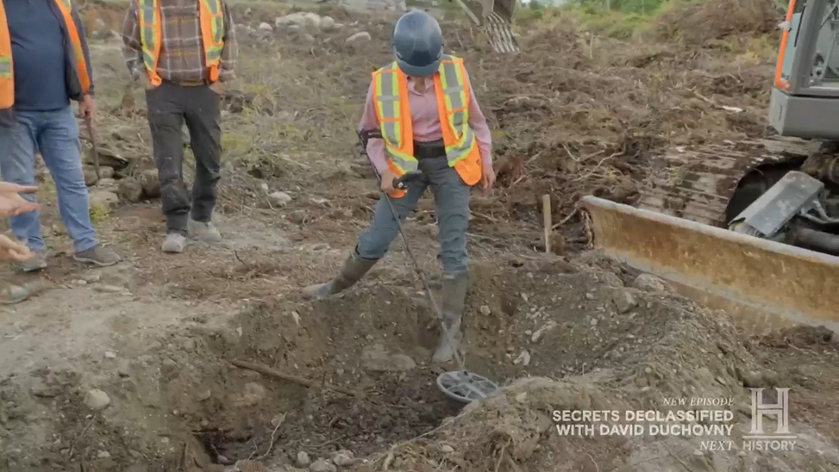

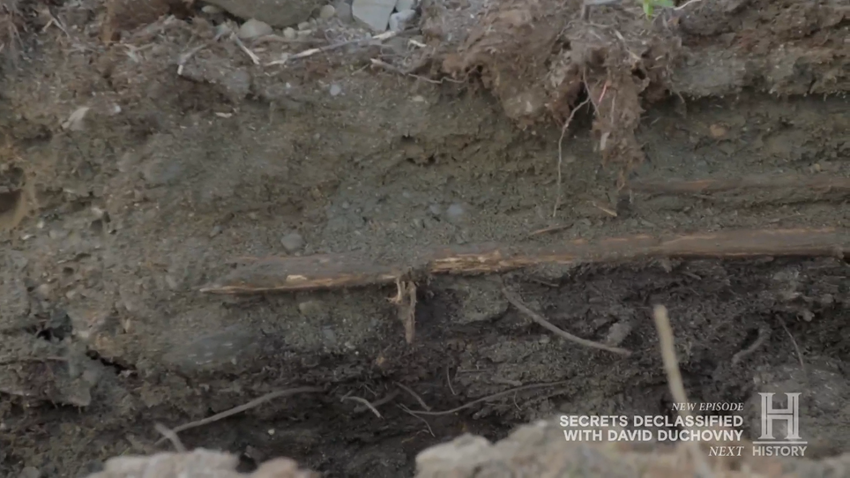
We were then taken back to the SOUTHWEST SWAMP AREA, where the Oak Island Team continued its exploration of this section of the Swamp. The team has brought over Dr. Ian Spooner who suggested that a crosscut swath of the apparent road be made to see if there was cut wood underneath it that could be dated. After some digging, Metal Detectorist, Katya Drayton had an iron hit and unearthed what appeared to be an ox shoe nail. This suggested to the team that oxen where used in this area to carry a heavy load and to transport something through this area. After more digging, they unearthed what appeared to be wood that was laid down as support for this road. Samples were taken and will be analyzed at the Lab and sent out for C-14 testing.

We were then taken to the PEACOCK AREA, where the Oak Island team continued its work in the PC-1 Drilling operation. The team had now reached a depth of 170 Feet and were bringing up buckets of material that was sent to the Wash Plant. Charles Barkhouse came over from that location and showed the team something that was found. It appeared to be a piece of cement. It was suggested that it could have been a piece of the Chappell Vault that was allegedly drilled into in 1897. It would be sent to the Lab for analysis.


The action then went to the WASH PLANT, where the Oak Island team continued to go through the spoils of the PC-1 Borehole. While working on the conveyor belt, Derek Couch found what appeared to be a piece of stone shot. This appeared to be the same type of shot that was previously found on the island and tied to the Portuguese and cited as evidence of their presence on Oak Island. It was mentioned that this artifact should not have been in this location, which was about 100 Feet in depth. It would be sent to the Lab for further analysis and testing.

We were then taken to the PEACOCK AREA, where the Oak Island team had reached a depth of 210 Feet in the PC-1 Borehole. Loose Gypsum was found but no wooden structure and nothing of significance other that the stone shot. The team declared that this hole was done and were very disappointed with the results. Although they commented that they weren’t giving up and would continue to search for the theorized treasure.

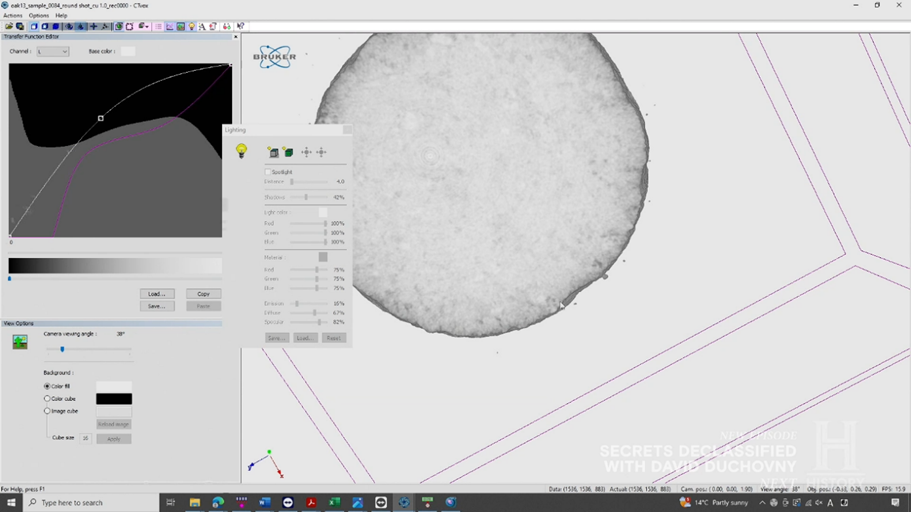
The scene shifted back to the LAB, where the Oak Island team met to discuss the stone shot found in the PC-1 Borehole. Archeometallurgist Emma Culligan completed a CT scan of the shot and mentioned that it had divots in it and was obviously working by humans. It was mentioned that this artifact could date from the 14th and 15th Century. It was mentioned that the other shot found previously was identified to be from the Azores and Madeira Islands, which were colonies of Portugal. It would be sent out to see if this artifact matches the same location of origin of the others.
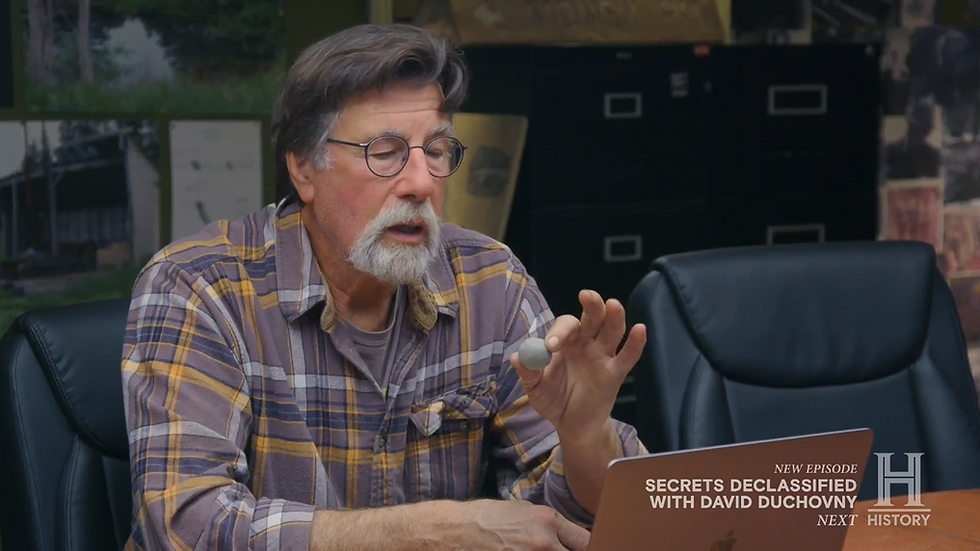
The episode concluded in the WAR ROOM where Rick Lagina teleconferenced with his brother Marty, regarding the present situation of the PC-1 Borehole. Rick relayed to Marty the lack of progress and ending of the search at that location. He showed Marty the stone shot found, which was the only tangible artifact found at the location. Marty inquired if it was the same as the other 1500’s shot that was found. Rick mentioned possibly the 1300’s and 1400’s. It wasn’t mentioned in the previous segment that the shot previously was determined to be most likely from the 1500’s during the Portuguese Age of Exploration and the time when they reportedly had a colony in Nova Scotia. Marty wondered if it was the same type of rock as the others and mentioned it being tested to confirm. It was stated that the results in PC-1 were less than they had hoped for and they would consult with Dr. Spooner and Dr. Michel for the next location of a drilling operation.
DANIEL’S ANALYSIS AND COMMENTARY:


During this week’s episode, the Oak Island team continued exploring the Southwestern Area of the Swamp and the remains of what appeared to be a road. The team seemed baffled by this road and how it got there. It should be noted that it had been stated in Crooker’s “Oak Island Gold” via Fred Nolan, that there was an old road that had been constructed before the Swamp had encroached and was used as a boundary between the lots. The first pictures attached clearly show the path of this road’s projection which mirrors the lot boundary that is visible on the Oak Island Map. It seems very likely that this road was the boundary indicated. It should be noted that along with the boundary, there was industrial activity in the Swamp area that could have utilized this feature as well. It seems highly unlikely that any of these features are associated with the Knights Templar in this author’s opinion.
It should also be noted that an old foundation was located in the vicinity of this road. It seems likely that the use of oxen were employed in both making the road/boundary and also farming that occurred in this area. The wooden stakes that have been found are what Fred Nolan called, “Survey Stakes”. This is exactly what they were and typical for the time period of the 1760’s in British North America when Oak Island was first surveyed and the lots drawn. The 5-and-8-sided wooden stakes were also typical during this time. It’s interesting to note that the numbers 5 and 8 are both important to Freemasons. Five being a sacred number and 8 being associated with moral discipline and division of time in the Mason’s life. Charles Morris, who drew the 1762 Map cited earlier, also surveyed Oak Island, and was a Freemason. This could possibly be another reason he used the stylized A’s that appeared on his maps.
Please follow our weekly episode analyses during Season 13, along with articles from the original “Compendium/Blockhouse Blog”, and special investigations and features involving Oak Island. Feel free to reach out to us for questions, comments, information and any theories to our email, theoakislandcompendium@gmail.com
Good day from Daniel of the Compendium!
THE OAK ISLAND COMPENDIUM © 2026


